

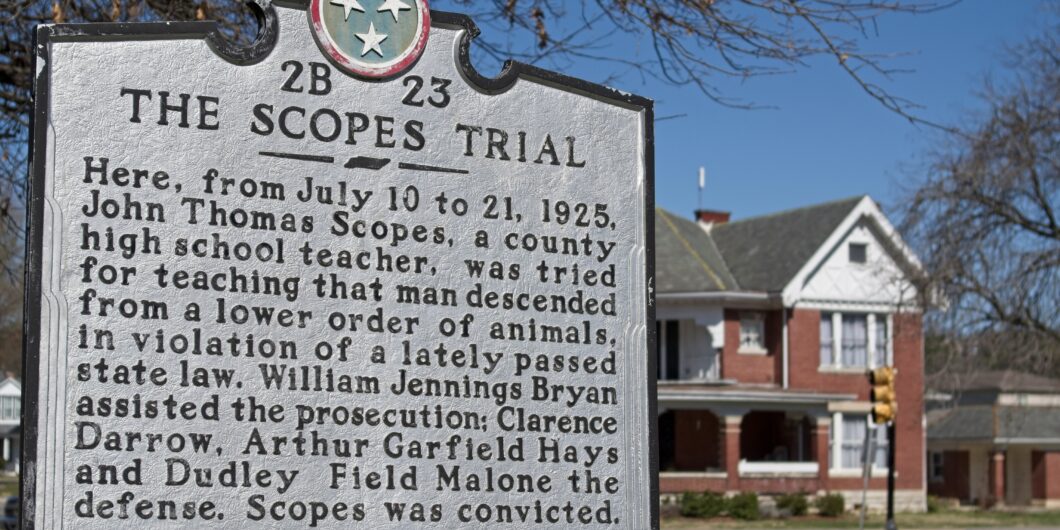
The 1925 prosecution of Tennessee highschool trainer John T. Scopes was a combination of excessive drama, comedy, and outright farce.
The laid-back, unassuming 25-year previous had allegedly violated a recently-passed state regulation banning the idea of evolution from being taught in public colleges. However Scopes himself, who by no means spoke a phrase till the ultimate day of the trial, obtained little discover. Crucial man on the trial was the particular prosecutor, a person with out whose participation “the trial of the century” might have solely been a historic footnote: William Jennings Bryan.
Bryan had spent years attempting to ban the idea of evolution from being taught in public colleges. Due to this, he was portrayed in his personal time, in addition to ours, as an ignorant, Bible-thumping fundamentalist who tried to ban science simply because it wasn’t constant together with his literalist interpretation of Genesis. But when we dig additional, we are able to see that Bryan’s arguments had been extra attention-grabbing and complex than he’s generally given credit score for. By analyzing his motivations and actions in context, we are able to acquire a deeper appreciation for exactly why the evolution ban was misguided, and what classes Bryan’s story can provide us as we navigate our personal cultural and tutorial controversies.
Two latest books on the trial can assist us by means of this fascinating historical past. The Trial of the Century, by lawyer and Fox Information host Gregg Jarrett and the sports activities journalist Don Yaeger, is a rollicking, extremely informative historical past of the trial. Their guide is usually instructed from the attitude of Scopes’ lead lawyer, Clarence Darrow. Gregg Jarrett even credit Darrow with inspiring him to develop into a lawyer, and his admiration for Darrow is obvious all through the guide. A lot of Darrow’s arguments form the best way Jarrett/Yaeger inform the story of the trial. Additionally they present a wonderful protection of liberal schooling on the finish of the guide. Sadly, their description of Bryan is shallow and infrequently slips into banal stereotypes.
Fortunately, Brenda Wineapple’s Conserving the Religion: God, Democracy, and the Trial that Riveted a Nation rectifies that by providing a extra balanced model of occasions. An expert historian, Wineapple usually avoids the temptation to inform the story of the Scopes trial as a easy good versus evil narrative. Leaning much less on the theatrical ambiance of the trial, she devotes more room to the backstories of her central characters, in addition to their political and cultural contexts, a lot in order that she doesn’t even get to the trial till greater than 200 pages into her guide. Studying Wineapple’s work alongside Jarrett/Yaeger’s permits a fuller image of Bryan to develop, giving us a greater thought about who he was and why his anti-evolution venture failed.
Generally known as the “Nice Commoner” as a result of he championed the reason for common folks towards financial and political elites, Bryan had been a significant participant in American politics for many years. A staunch Progressive, he was the Democratic Occasion’s presidential nominee 3 times—1896, 1900, and 1908, shedding every time. Within the early Twenties, he started touring the nation and preaching towards evolution, hoping to get it banned from college curricula. As a religious Christian, Bryan was involved about rising ranges of atheism within the West, fueled by the more and more widespread acceptance of Darwinian evolution.
His anti-evolution marketing campaign received its first victory when, in March 1925, Governor Peahy of Tennessee signed the Butler Act, which forbade any public college, together with state universities, from educating “any concept [that] denies the story of the Divine Creation of man as taught within the Bible, and to show as an alternative that man has descended from a decrease order of animals.”
Shortly after the invoice was signed, the American Civil Liberties Union (ACLU) jumped into motion. Their attorneys argued that the Butler Act denied academics and college students their First Modification proper to non secular liberty, and had been desirous to problem the regulation in court docket. They put out an commercial in papers across the state, asking for a volunteer to supply himself up for prosecution and promising to characterize him.
A bunch of businessmen within the little city of Dayton noticed the commercial and thought it may very well be an incredible alternative to realize some publicity, which might hopefully rejuvenate the stagnant native economic system. They reached out to their pal and native highschool trainer John Scopes, who agreed to be charged. The native prosecutor, who was in on the scheme, contacted Bryan and invited him to function a particular counsel. Bryan readily agreed.
“America has taken one other step again to the Darkish Ages,” declared Clarence Darrow in response to the information in regards to the Butler Act. Darrow was maybe probably the most well-known trial lawyer in America, having participated in among the most high-profile instances of the late nineteenth and early twentieth centuries, the place he defended labor organizers and black victims of racial violence.
When he heard that Bryan could be serving on the prosecution, Darrow shortly volunteered his companies to the ACLU. He noticed the Scopes trial as a chance to “show that America is based on liberty and never on slim, imply, insupportable and brainless prejudice of soulless religio-maniacs.” Darrow smeared Bryan earlier than, throughout, and after the trial as an ignorant, bigoted, wanna-be theocrat, however as Wineapple exhibits, Bryan’s place was rather more nuanced than Darrow gave him credit score for. Within the first place, he was hardly an opponent of science general. In truth, he publicly acknowledged the huge advantages that scientific progress had afforded mankind. In line with him, although, evolution was totally different.
Whereas the state can and may present pointers for what’s allowed to be taught in public colleges, these pointers ought to be broad—definitely broad sufficient to incorporate a significant, evidence-based, mainstream scientific concept.
Like others within the nascent fundamentalist motion, Bryan believed that Darwinism contradicted the Bible’s account of creation. But it surely was the metaphysical and social implications of evolution that bothered him probably the most. Christianity taught that each one human beings, no matter their circumstances or skills, had intrinsic worth. Darwinism, however, taught that solely the fittest survive. It wasn’t a far leap—and many individuals on the time did make the leap—to say that solely the fittest ought to survive. If Darwinian evolution had been accepted as reality, Bryan feared, the strongest of the human species may kill off the weak. Wineapple notes that Bryan additionally fearful in regards to the state regulating human copy, within the identify of enhancing the human race. In Bryan’s phrases, the state might institute “a system of breeding below which a couple of supposedly superior intellects, self-appointed, would direct the mating and the motion of the mass of mankind—an unattainable system!” This was social Darwinism in motion.
Wineapple writes that Bryan “confused social Darwinism with the idea of evolution,” implying that since Bryan hadn’t learn a lot biology, he merely couldn’t inform the distinction between the science of evolution and the pseudoscience of eugenics. However the reality is that almost all of Bryan’s contemporaries, together with the nation’s prime scientists, believed that social Darwinism was the logical conclusion of the organic concept of evolution. As Nicholas Spencer writes in his guide on the entangled histories of science and faith, “Just about nobody, whether or not adamant fundamentalist or evolutionary atheist, thought Darwinism was ‘mere’ biology.”
Certainly, the very textbook utilized by Scopes in his classroom, G. W. Hunter’s A Civic Biology, explicitly says that social issues are primarily organic at their core. “If the inventory of domesticated animals could be improved,” Hunter writes, “it’s not unfair to ask if the well being and vigor of the longer term generations of women and men on the earth is likely to be improved by making use of to them the legal guidelines of choice.” He goes on to jot down positively of eugenics, saying that if the “parasites” of society weren’t human, “we might in all probability kill them off to stop them from spreading. Humanity is not going to enable this, however we do have the treatment of separating the sexes in asylums or different locations and in varied methods stopping intermarriage and the probabilities of perpetuating such a low and degenerate race.”
The concept that Darwinism would develop into the justification for eugenics wasn’t simply an irrational concern dreamed up by Bryan. It was already changing into a actuality. By 1925, dozens of states had handed pressured sterilization legal guidelines. As Spencer notes, these states “sterilised criminals, drunks, promiscuous girls, ‘morons’ and ‘imbeciles’ (‘scientific’ definitions of intelligence), in addition to various unemployed, disabled and black residents.” Between 1920 and 1970, as many as 70,000 Individuals underwent obligatory sterilization.
Bryan was horrified on the considered governments forcibly sterilizing folks within the identify of “enhancing” the human species. Sadly, he threw the child out with the bathwater. Although broadly well-liked on the time, social Darwinism and its extra evil twin, eugenics, weren’t the identical factor as, or perhaps a obligatory consequence of, the idea of evolution. Bryan might not have confused these concepts, however he did see eugenics because the fruit of a rotten tree. If the West was to be saved from tyranny and ethical decadence, the entire evolutionary tree wanted to be hewn down.
Bryan believed the widespread folks might accomplish this by exercising their proper to manage what will get taught in public colleges. In Conserving the Religion, Wineapple writes about how essential the democratic ethos was for Byran. “The hand that writes the paycheck guidelines the college,” he mentioned in a single speech. It might be lunacy, he thought, for the folks to pay academics for the privilege of turning their kids into atheists. And but, that is precisely what colleges had been doing by educating evolution as an undeniable fact. By this logic, it was the evolutionists who had been limiting spiritual freedom, not the creationists.
Scopes’s protection attorneys weren’t shopping for it, although. They pointed to the explicitly spiritual language of the Butler Act and famous that there was even a major variety of Christians who noticed no contradiction between “the story of the Divine Creation of man as taught within the Bible” and the idea of evolution. By utilizing a selected type of Christianity to form college curricula, the state had successfully established a state faith. This was mainly the identical conclusion that the Supreme Courtroom got here to within the 1968 case Epperson v. Arkansas, when it declared that an Arkansas anti-evolution regulation, which used nearly similar language to the Butler Act, had violated the Institution Clause of the First Modification.
Of their concluding chapter, Jarrett/Yaeger argue that state anti-evolution statutes weren’t simply unconstitutional—they had been additionally antithetical to the aim of schooling, which is to facilitate “the free trade of concepts and data, nonetheless unpopular they could be.” Bryan’s nice failure is that he thought he might save Western civilization by means of censorship. And whereas the state can and may present pointers for what’s allowed to be taught in public colleges, these pointers ought to be broad, definitely broad sufficient to incorporate a significant, evidence-based, mainstream scientific concept.
Even when actual science will get twisted by ideologues, like evolution was by the social Darwinists, utilizing the ham-handed fist of presidency to snuff it out solely deprives college students of the chance to interact with the topic. Jarrett/Yaeger examine the anti-evolution statutes to modern-day insurance policies forcing important race concept (CRT) into school rooms. Academics and college students who dissent from these politically leftist curricula are typically punished. Alternatively, legal guidelines banning CRT usually have an unintended chilling impact on academics, lots of whom are actually afraid of educating something in regards to the historical past of race relations, particularly probably the most controversial elements, lest they be accused of breaking the regulation. Jarrett/Yaeger persuasively argue that the pro- and the anti-CRT facet go too far by mandating the conclusions that college students should come to, relatively than permitting school rooms to be a “market of concepts” the place “data ought to be freely exchanged.”
That simply wouldn’t do for Bryan. He was, as Wineapple concludes, a “Christian utopianist” who firmly believed that he might use authorities regulation to create a greater world. However by attempting to impose his worldview by power of regulation, he tarnished his private popularity and that of his motion, which was seen as intolerant, backwards, and repressive. Providentially, maybe, he went to fulfill his Maker only some days after the trial ended. In the end, Bryan’s ultimate campaign towards evolution is a cautionary story in regards to the sensible limitations of state energy. It’s a story effectively value finding out.