

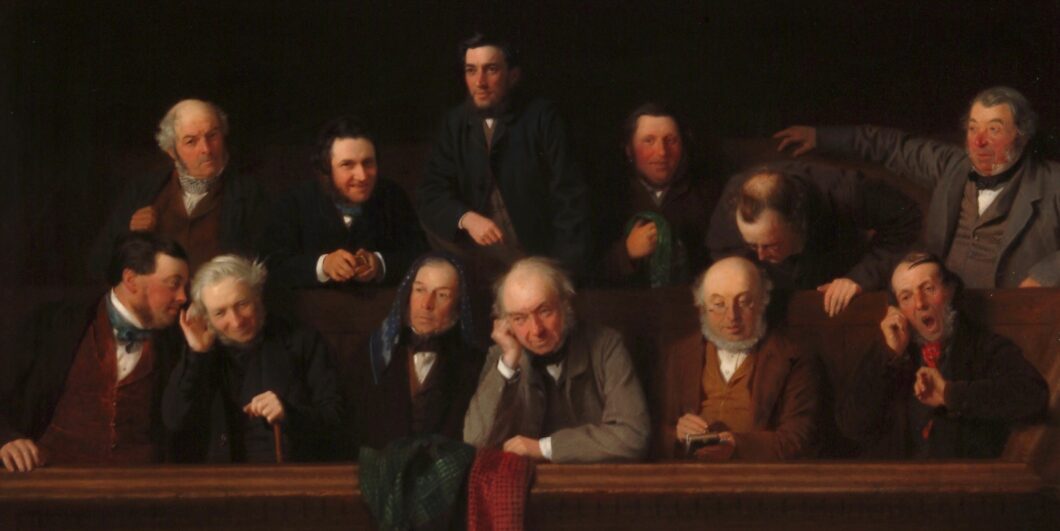
How a lot cash would you promote your historic liberties for? Or let’s put it one other approach: how a lot cash would you want the federal government to avoid wasting in a trade-off for a vital aspect of freedom and justice within the English-speaking world? The traditional freedom to which I’m referring is the widespread regulation establishment of trial by jury. David Hume, in The Historical past of England, referring to “trial by … jury of twelve freeholders,” believed that this establishment is “very historic in England, and was fastened by the legal guidelines of King Alfred.”
So, how a lot cash for this historic establishment? How about for £31 million (or simply over $41.6 million). Let’s put that sum of cash into context. As Robert Jenrick MP, the Conservative Shadow Secretary of State for Justice, famous, this sum is merely 0.2 % of the UK’s Ministry of Justice finances. Regardless of the minimal financial savings which might be estimated, the Labour administration within the UK is contemplating limiting this foundational judicial process. As an illustration, crimes from sexually assaulting a baby to fraud could also be restricted to judge-alone trials.
Adam Smith in his Lectures on Jurisprudence stated, “The regulation of England, all the time the good friend of liberty, deserves reward in no occasion greater than within the cautious provision of neutral juries.” Writing about “procedural safeguards,” corresponding to trial by jury, F. A. Hayek famous in The Structure of Liberty that in “Anglo-Saxon international locations,” these safeguards appear “to most individuals because the chief foundations of their liberty.” Certainly, the establishment of trial by jury is the cornerstone of the felony justice system and is deeply rooted throughout the authorized custom and follow in Anglo-American regulation.
Eradicating juries additionally removes, as Tocqueville expressed it, “a mode of sovereignty of the individuals.”
Because the scholar Harry Potter famous in his e-book Legislation, Liberty and The Structure, 1166 was a major second as a result of Henry II, after counsel and session, “promulgated the Assize of Clarendon,” and “this was a landmark within the historical past of the jury.” Roger Scruton in England: An Elegy notes that the jury with its Saxon and Norman components “took one thing like its trendy type following Assize of Clarendon.” Certainly, a jury and its impartiality are essential to our conception of justice. Moreover, the very existence of a jury is central to our concept of the rule of regulation. Alexis de Tocqueville in Democracy in America wrote:
When the English adopted the establishment of the jury, they had been a half-barbaric individuals; they’ve since turn into probably the most enlightened nations of the globe, and their attachment to the jury has appeared to extend with their enlightenment.
This attachment doesn’t appear to be shared by this current Labour administration. After all, Sir Tony Blair, when he was Prime Minister, additionally endeavored to limit the best to trial by jury. Certainly, Labour has a unfavorable observe document on our constitutional heritage.
So, if you wouldn’t throw this liberty away for the cash, how about saving a little bit of time and releasing up some sitting days? Say, 9,000 Crown Court docket sitting days a 12 months? Sarah Sackman, a Labour MP and a authorities minister, expressed within the Home of Commons that the “Lord Chancellor commissioned Sir Brian Leveson to undertake a once-in-a-generation evaluate of the felony courts.” The results of this fee was a report by Brian Leveson known as Unbiased Assessment of the Felony Courts. To make use of an idea that was partly developed by George W. Cary, the report lacks “constitutional morality.” Sir Brian appears to refuse to “abide by the restrictions and imperatives” of the British constitutional custom. As an illustration, he claims within the report that there exists no constitutional or certainly “any type of basic widespread regulation proper to trial by decide and jury.” Furthermore, he claims that Magna Carta doesn’t present “a authorized foundation to assert a proper to a jury trial as a constitutional proper.” Leveson has stated that Magna Carta solely refers to trial by “friends” not “jury.” It does seem that he’s calculating that his sophistry will likely be persuasive sufficient for the federal government to make economies within the judicial system regardless of the constitutional immorality.
The report is wide-ranging, however for our function right here, I shall concentrate on his suggestions to the Labour administration for adjustments to trial by jury. His suggestions are:
(1) Defendants ought to have the ability to elect to not have a trial by jury;
(In England and Wales, there’s a very restricted proper to this, e.g., the place there’s a concern about jury tampering, not like within the US, the place with the ability to select between jury or bench trial is pretty widespread.)(2) There must be judge-alone trials when the trials could also be lengthy and sophisticated;
(3) Trial by jury shouldn’t be utilized in severe and sophisticated fraud circumstances.
As John Randolph of Roanoke had steered, there’s a distinction between change and reform. These suggestions should not meant to reform, enhance, and strengthen our current ideas of justice however to alter them. One would have thought that the Labour administration would recoil from such suggestions and likewise distance itself from the report. However no! The Minister of State within the Ministry of Justice on the dispatch field within the Home of Commons stated that the Authorities welcomes “the formidable suggestions that he has put ahead.” Why, it’s possible you’ll ask? As a result of, based on the Minister, the Labour Authorities “should take into account any measures that can put our courts on a extra secure and sustainable footing.” In different phrases, to avoid wasting money and time. Maybe, the minister didn’t imply that the federal government welcomes the curbing of jury trials, however the report normally? No, this isn’t the case as Sackman stated, “We’ll rigorously take into account Sir Brian’s suggestions on jury trials, together with all the things else, earlier than offering a proper response to Parliament within the autumn.”
The explanations offered by Leveson, who has a observe document of endeavoring to limit the usage of trial by juries, for these suggestions for diluting this core safeguard for our freedom are revealing. Leveson doesn’t imagine that the jurors have the capability to know the complexity of fraud circumstances. He makes this plain, writing that circumstances which might be “severe” or “advanced” “must be tried by decide alone.” These circumstances will likely be “outlined by their hidden dishonesty or complexity that’s outdoors the understanding of most people,” and that Leveson believes it’s “tough for the jury to know or assess … among the proof.” Once more, he does assume that most people is less than the job of justice and believes that the “growing size of trials” and the “substantial burdens positioned on jurors” are an excessive amount of of a burden on bizarre individuals.
Turning to Adam Smith once more, the Scotsman noticed that “the jurymen are your neighbours who’re to evaluate of a truth upon which your life relies upon.” Leveson wishes to take away your neighbors from the judicial course of, and the Labour administration “welcomes” it. Russell Kirk wrote in America’s British Tradition that “the English individuals seemed upon widespread regulation as their regulation, the product of their historic expertise; it was not one thing imposed upon them from above.” Sir Roger Scruton equally argues that the “concept of the regulation of the land” drew “credibility” from two key procedures, and one was trial by jury. If the Labour administration implements Leveson’s suggestions, it can partially take away one of many core pillars of credibility of the regulation. Eradicating juries additionally removes, as Tocqueville expressed it, “a mode of sovereignty of the individuals.”
This mode of sovereignty of the individuals is important because it acts as a democratic examine on the facility of the state. As an illustration, Scruton argued that the jury system “ensured that the regulation remained conscious of the bizarre conscience, since juries wouldn’t convict if the penalty gave the impression to be extreme or the crime a mere formality.” Certainly, Adam Smith argued that “individuals are usually disposed to favour innocence” in felony circumstances. Eradicating juries and changing them with new judge-alone courts is not going to guarantee any of the advantages that improve our liberty and justice that juries present. Having most people, by way of jury responsibility, take part within the administration of justice improves and enhances the status of the regulation and ensures that most people sees the regulation as ours and that it’s liberty-enhancing and enabling reasonably than a top-down imposition on our freedom.
Sir Patrick Devlin remarked that “trial by jury is greater than an instrument of justice and a couple of wheel of the structure: it’s the lamp that exhibits that freedom lives.” It appears to me that this Labour administration wishes to extinguish the lamp that exhibits freedom lives in far too many areas of British life, together with trial by jury.