

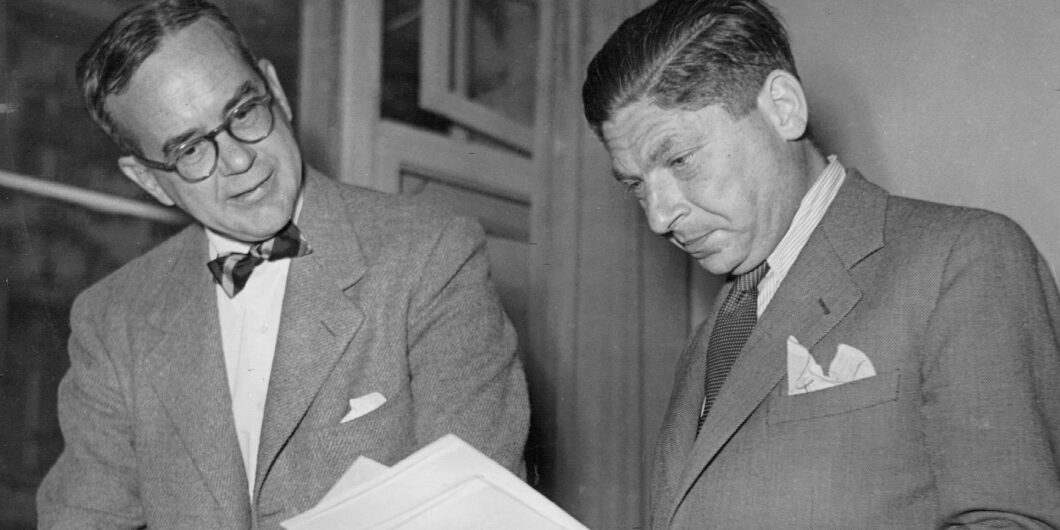
Friends at James and Marcia Burnham’s dinner desk in the course of the Nineteen Thirties have been typically interrupted by a knock on the door.
One minute they’d be speaking in a tony Manhattan condominium. The subsequent they’d be watching Burnham, wearing formal apparel, huddle with a seedy-looking fellow within the entryway. The 2 would change conspiratorial gossip. Abruptly the stranger would depart, and Burnham would return to his mates, appearing as if nothing had occurred. The get together would go on.
The dapper Burnham, a professor of philosophy at NYU, was on the time a Marxist revolutionary. A number one determine within the Employees Celebration of the US, he was not your typical bohemian. Burnham was fortunately married, had three youngsters, held a gradual job, and lived in a well-appointed residence. All whereas serving as level man for Leon Trotsky—Bolshevik hero, founding father of the Pink Military, and Soviet exile.
“There was one thing weird,” recalled Burnham’s buddy and colleague Sidney Hook, “about this scion of a rich Midwestern Catholic industrialist, a product of Princeton and Oxford, who had delivered his oration as a category valedictorian in Latin, coming into the lists as a protagonist of the working class.”
The distinction between Burnham’s outward conference and internal radicalism remained, even after he left Marxism and joined the American Proper. Burnham’s cool exterior all the time contained a sweeping, apocalyptic thoughts.
In James Burnham: An Mental Biography, historian David T. Byrne traces the thinker’s path from The New Worldwide to Nationwide Assessment. It is a helpful introduction to Burnham’s thought. Whereas not a definitive remedy, Byrne’s concise and accessible survey illustrates Burnham’s enduring attraction to conservatives, many years after he died in 1987.
Burnham was born in Chicago in 1905. His father was within the railroad enterprise, and household wealth gave him entry to journey, sports activities, and training. He was a wonderful scholar. He started writing quick tales whereas at Catholic boarding faculty and fell in love with philosophy whereas at Princeton. After graduating in 1927, he went to Balliol School, Oxford. He studied literature.
In 1929, Burnham returned to America to show at NYU. He gave no indication throughout these early years that he would swerve to the left. His pursuits have been literary, aesthetic, ethical. He emulated the syllogistic reasoning of St. Thomas Aquinas. Burnham’s radical flip, Byrne speculates, might have been attributable to a traumatic breakup in 1932.
The easier clarification is that Burnham, like a lot of his friends, was shocked and dismayed by the Nice Despair. Standard explanations for financial collapse and mass unemployment didn’t fulfill him. For younger intellectuals akin to Burnham, radical options weren’t simply believable. They have been vital. He learn Sidney Hook’s essay “In the direction of the Understanding of Karl Marx” and was satisfied that the communist revolution needed to end result from political activism.
Conservatism is the rejection of ideology, and the dealing with of actuality—which is why Burnham joined the Proper.
Hook taught Burnham that energy was important to politics, each nationwide and worldwide. “And this seizure of energy,” writes Byrne, “primarily trusted ‘will and group.’ Decided people should lead.” Leon Trotsky’s Historical past of the Russian Revolution, just lately translated into English, strengthened these classes. Energy and pressure of will turned key ideas in Burnham’s writing.
In 1933, Burnham introduced that he was a Marxist. Inside a yr, he had joined the American Employees Celebration and sided with Trotsky towards Soviet dictator Joseph Stalin. By inspecting sectarian debates over nationalism, imperialism, and Stalin, Byrne identifies rising themes in Burnham’s work.
The Despair ended laissez-faire capitalism, Burnham argued. “Democracy” was a slogan, appearing as cowl for rule by FDR’s mind belief. And the left’s peace camp was foolish. “For Burnham,” writes Byrne, “disarming within the midst of a raging wrestle benefited solely the enemy. He would all the time imagine this.”
Burnham’s encounter with Marxism outlined him. The ideology equipped analytical instruments that he would apply, briefly, to advancing revolution—after which, for much longer and extra successfully, to rolling it again.
Over time, Burnham turned disillusioned with “scientific socialism.” Marxism couldn’t be examined, he mentioned. It was impervious to reality. Soviet depravity provoked second ideas as properly. In 1937, Stalin’s purges and show-trials put the deceive fellow-traveling propaganda. When the Soviets, together with their Nazi allies, invaded Poland in 1939, Burnham attacked Stalin as an imperialist. He disputed that the Soviet Union was a “employee’s state.”
Such heresy made Burnham enemies. He broke with Trotsky. He left the Employees’ Celebration in Might 1940.
By then, Burnham was at work on The Managerial Revolution, revealed to nice acclaim in Might 1941. His thesis was that free-market capitalism was moribund as a result of possession of enterprise had grow to be separated from management. Capitalists have been on the mercy of boards, managers, and authorities. The New Deal, fascism, Nazism, socialism, and Stalinism have been simply totally different names for a similar factor: rule by centralized bureaucracies.
The Managerial Revolution made Burnham’s repute. It additionally exemplified his strengths and weaknesses as an analyst. Nobody might argue with Burnham’s polemical verve and mental chops. But, as George Orwell noticed, Burnham tended to magnify the power of whichever nation-state appeared strongest at a given second. His forecasts merely prolonged present developments.
In The Machiavellians, revealed in 1943, Burnham studied the authors who had formed his methodology of political evaluation. What at first reads as a dry examine in Italian elite concept—that each one types of authorities, together with democracy, function masks for elite manipulation—is in reality a playbook for the protection of liberty in a managerial society. Freedom, Burnham argued, is the proper to oppose authority. And free societies are superior to totalitarian ones, such because the Third Reich and USSR, as a result of they encourage innovation and adaptation.
By 1947, Nazism and Japanese militarism have been gone. However the Soviet Union remained. Burnham threw himself into describing the brand new world state of affairs whereas advocating for American victory within the Chilly Battle. Starting with The Battle For the World, his “Chilly Battle” trilogy painted a bleak image. Communism was advancing alongside each entrance. US elites neither perceived the risk precisely nor possessed the need to defeat such an all-consuming ideology. To win, Burnham argued, America should keep its monopoly on nuclear weapons. It should embrace empire.
In subsequent volumes—The Coming Defeat of Communism (1950) and Containment or Liberation? (1953)—Burnham mentioned that America should undertake new ways. Army energy was vital however not enough. What Burnham known as political warfare—often known as psywar—was required. Utilizing psywar, America might stress the Soviets with propaganda. It might encourage dissent throughout the communist ruling class. Monetary and rhetorical help for nationalist teams throughout the Soviet Empire would promote liberation.
Burnham rapidly turned often called certainly one of America’s foremost thinkers. His work took him to the CIA, the place he met a latest Yale graduate named William F. Buckley Jr. Publicly, Burnam joined the Committee for Cultural Freedom, a gaggle of anti-communist liberal intellectuals combating Stalinist affect on Western thought.
Some People have been uncomfortable with the implications of psywar. However communists weren’t. Propaganda, infiltration, and subversion have been amongst their favourite instruments. Espionage had introduced the Soviets the atom bomb.
In 1950, Senator Joseph McCarthy of Wisconsin introduced that he had recognized communists working contained in the State Division. For the following 4 years, McCarthy was the focus of American politics. His populist campaign rattled Democrats and compelled anti-communist intellectuals to decide on sides: Had been you for or towards McCarthy?
Burnham selected the Tail Gunner. Disapproving of the senator’s ways, he nonetheless believed that McCarthy was severe about communism in ways in which liberals weren’t. “For my part these anti-cs who take into account themselves to be anti-McCarthyites have fallen right into a entice,” he wrote to a buddy in 1954. “They’ve failed up to now to appreciate that they’re, in political actuality, in a united entrance with the Communists, within the broadest, most imposing united entrance that has ever been constructed on this nation. As in all united fronts, solely the Communists can profit from it.”
Simply as he had damaged off from Trotsky over the USSR, Burnham break up with liberals over McCarthy. To Burnham, neither the Previous Man nor historian Arthur M. Schlesinger Jr. accurately perceived actuality. Trotsky was caught within the imaginative and prescient of the revolution betrayed, whereas Schlesinger’s liberalism blinded him to communist evil. Burnham’s estrangement from the Left, then from liberalism, alienated him from mainstream establishments. He stop the Congress for Cultural Freedom. He stopped writing for the distinguished Partisan Assessment.
And he joined Buckley’s fledgling Nationwide Assessment. From its debut in 1955 till his retirement in 1978, Burnham was, in Buckley’s phrases, “the dominant mental affect” on the journal. His standing underscored the paramount significance of anticommunism on the American Proper. As Byrne notes, “Burnham by no means thought of himself a conservative Republican.” He was a Machiavellian, a dispassionate strategist whose chief concern was international coverage. On a number of home points, Burnham was a reasonable. He had no objection to restricted intervention within the financial system. Libertarianism left him chilly.
But Burnham held many conservative positions. His final main works took purpose at fashionable liberalism and the welfare state. Congress and the American Custom (1959) defended federalism, the Structure, and the primary department of presidency towards unwieldy presidential energy, which Burnham dubbed “Caesarism.” 5 years later, Suicide of the West recognized fashionable liberalism as an ideology tailor-made for managed decline, a guilt advanced that sapped the need to withstand armed doctrines akin to communism and anticolonialism. “When the Western liberal’s feeling of guilt and his related feeling of ethical vulnerability earlier than the sorrows and calls for of the wretched grow to be obsessive,” Burnham wrote, “he typically develops a generalized hatred of Western civilization and of his personal nation as a part of the West.”
A stroll by any elite campus at present confirms his prognosis.
Burnham was in his mid-60s when Suicide of the West was revealed. His closing decade as a author was dedicated to Nationwide Assessment. His columns handled US entanglement in Vietnam and the protracted battle with the Soviet Union. He criticized President Nixon’s international coverage of détente with the USSR and wrote Senator James Buckley’s March 1974 speech calling for Nixon to resign over Watergate. In 1978, on a particular episode of Firing Line, he joined Buckley to defend the Panama Canal Treaties. On the opposite aspect of the talk was Ronald Reagan.
Freedom, Burnham argued, is the proper to oppose authority. And free societies are superior to totalitarian ones, such because the Third Reich and USSR, as a result of they encourage innovation and adaptation.
A sequence of strokes pressured Burnham to place down his pen. When President Reagan awarded him the Presidential Medal of Freedom in 1983, Burnham won’t have realized the total extent of his attain. “All through the years touring the mashed-potato circuit I’ve quoted you broadly,” Reagan joked.
That was an understatement. Reagan put into apply anti-communist methods that Burnham had outlined way back. Reagan’s navy buildup, his addresses to the British parliament and to the Nationwide Affiliation of Evangelicals, his Strategic Protection Initiative, and his help for anti-communist rebels in Nicaragua, Angola, and Afghanistan—all these will be traced to Burnham’s writings within the ’40s and ’50s.
Burnham died at his residence in Kent, Connecticut, in 1987, two years earlier than the Tiananmen Sq. rebellion and the autumn of the Berlin Wall. When the Soviet Union dissolved on the finish of 1991, Marxism was tossed into the ash heap of historical past. Or so it appeared.
Burnham’s mental legacy is most clearly seen in Reagan’s presidency. But Daniel T. Byrne seeks to attract connections between Burnham and a subsequent GOP president: Donald Trump. Grappling with up to date divisions in American conservatism, Byrne argues there have been two James Burnhams: “one an embryonic neocon, and the opposite a paleoconservative paragon.” Burnham’s neocon aspect, in keeping with Byrne, believed within the utility of pressure. His paleocon half dwelt on democracy’s issues and the managers’ faults.
This distinction is pressured. From the angle of 2025, it might appear as if help for international intervention runs towards skepticism of democracy and its elites. However that isn’t essentially the case. Burnham didn’t discover his considered contradictory—that may have violated his dedication to logic, motive, syllogism, and reality. As he favored to inform younger Nationwide Assessment staffers, “He who says A should say B.”
Neither is it proper to say that “Burnham was an ‘America Firster,’” within the context of that time period’s present which means. Burnham might have opposed US entry into World Battle II, alongside together with his fellow Trotskyists, however he rapidly dropped his objections after Pearl Harbor. And he backed direct and oblique interventions for the remainder of his life. The largest stars in Burnham’s mental cosmos weren’t Charles Lindbergh and Russell Kirk, however Karl Marx and V. I. Lenin. Aligning with conservatives in a shared trigger didn’t imply that he slot in with them. Certainly, Burnham by no means slot in with anybody.
To Burnham, managerialism, elite concept, and energy politics have been merely the best way the world works. Working throughout the system he described, he really useful insurance policies that may advance American pursuits and thwart communist ones. So intently was he related to communism, for and towards, that it’s inconceivable to say for sure the place he would have landed in post-Chilly Battle international coverage debates. A lot much less in up to date ones.
“Having come to know one thing of the big ideology of Bolshevism,” Burnham wrote in 1963, “I knew that I used to be not going to have the ability to accept the pigmy ideologies of Liberalism, social democracy, refurbished laissez-faire, or the inverted, cut-rate Bolshevism known as ‘fascism.’” Conservatism is the rejection of ideology, and the dealing with of actuality, which is why Burnham joined the Proper.
There might have been two James Burnhams within the Nineteen Thirties, when the upright skilled welcomed revolutionaries into his residence. But ultimately there was only one Burnham: Sensible, penetrating, and implacably devoted to the destruction of the communist enterprise.