

On December 16, 2025, the U.S. Nationwide Institute of Requirements and Expertise (“NIST”) revealed a preliminary draft of the Cybersecurity Framework Profile for Synthetic Intelligence (“Cyber AI Profile” or “Profile”). In accordance with the draft, the Cyber AI Profile is meant to “present tips for managing cybersecurity threat associated to AI methods [and] establish[] alternatives for utilizing AI to reinforce cybersecurity capabilities.” The draft Profile makes use of the prevailing voluntary NIST Cybersecurity Framework (“CSF”) 2.0 — which “supplies steerage to trade, authorities companies, and different organizations to handle cybersecurity dangers” — and overlays three AI Focus Areas (Safe, Detect, Thwart) on high of the CSF’s outcomes (Features, Classes, and Subcategories) to counsel issues for organizations to prioritize when securing AI implementations, utilizing AI to reinforce cybersecurity defenses, or defending in opposition to adversarial makes use of of AI. This draft steerage will possible be acquainted to organizations that already leverage the CSF 2.0 of their cybersecurity applications and is likely to be complimentary to current frameworks that organizations have already got in place. Even so, the outcomes are designed to be versatile such {that a} vary of organizations (with mature or novel applications) can leverage the steerage to assist handle AI-related cybersecurity threat.
For entities or stakeholders that is likely to be excited by providing suggestions on the preliminary draft, NIST is planning to host a workshop on January 14, 2026, to debate the draft. The Profile can also be open for remark till January 30, 2026. Under, we briefly summarize the Profile’s organizational construction, in addition to areas on which NIST is searching for public remark.
Focus Areas
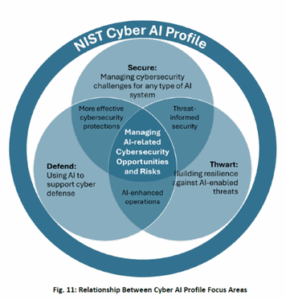
The Cyber AI Profile is organized into three Focus Areas that deal with AI-related cybersecurity threat from totally different however overlapping angles.
- Safe – “[F]ocuses on managing cybersecurity challenges when” organizations combine an AI system into their surroundings. Examples of using AI that fall inside the scope of Safe embrace using AI by “[p]ower grids to stability masses” and “[c]ustomer service organizations to carry out preliminary interactions with prospects.”
- Defend – Goals to establish alternatives for the makes use of of AI that assist cybersecurity processes and actions. For instance, AI can improve cyber protection capabilities associated to mission assurance, proactive threat administration, predictive upkeep and threat forecasting, “[a]dvanced risk detection and evaluation,” adversarial coaching and simulation, and automatic incident response.
- Thwart – Emphasizes constructing resilience to guard in opposition to AI-enabled threats. For instance, AI-enabled spear-phishing assaults exploit customers by means of extra practical manipulation utilizing deepfakes and generative AI. These AI-enabled assaults assist stress the necessity to replace coaching for personnel and to have automated defenses that bolster safety measures.
Cybersecurity Framework 2.0 Core
As indicated above, the Cyber AI Profile is split into the six CSF capabilities: Govern, Establish, Defend, Detect, Reply, and Get better. Inside every CSF perform, the Cyber AI Profile presents pattern focus space issues. Just like the CSF 2.0, the Cyber AI Profile doesn’t provide particular directions for how you can obtain the really helpful outcomes however as an alternative supplies references for the way a corporation may think about reaching the really helpful outcomes — instance informative references embrace sources resembling technical papers, the European Union Company for Cybersecurity’s (“ENISA”) Risk Panorama 2025 paper, NIST Particular Publication (“SP”) 800-218, and Databricks AI Safety Framework Model 2.0. The Cyber AI Profile additionally presents really helpful priorities to assist decide which Subcategory organizations ought to prioritize: “1” for Excessive Precedence, “2” for Reasonable Precedence, and “3” for Foundational Precedence.
Govern
The Govern profile captures the institution, communication, and monitoring of “[t]he group’s cybersecurity threat administration technique, expectations, and coverage.” This profile is additional divided into the CSF classes of (1) group context, (2) threat administration technique, (3) roles, tasks, and authorities, (4) coverage, (5) oversight, and (6) cybersecurity provide chain threat administration. AI issues beneath these classes embrace, for instance:
- Safe/Defend: Figuring out and speaking AI dependencies.
- Safe/Defend: “[I]ntegrat[ing] AI-specific dangers into the group’s formal threat urge for food and tolerance statements.”
- Defend/Thwart: Growing AI-specific risk data sharing channels.
- Defend: Augmenting cybersecurity groups with AI brokers.
- Defend: Utilizing AI to conduct governance checks to establish operational conflicts.
- Defend: Conducting risk detection of supplier-provided AI fashions.
Establish
The Establish profile focuses on guaranteeing that “[t]he group’s cybersecurity dangers are understood.” This profile contains the CSF classes of (1) asset administration, (2) threat evaluation, and (3) enchancment. AI issues beneath these classes embrace, for instance:
- Defend: Inventorying software program and methods to incorporate “AI fashions, APIs, keys, brokers, knowledge . . . and their integrations and permissions.”
- Defend/Thwart: Incorporating AI-specific assaults as a part of one’s vulnerability administration program.
- Defend: “Defin[ing] situations for disabling AI autonomy throughout threat response.”
- Defend: Integrating “AI-specific procedures for containment” throughout incident response.
Defend
The Defend profile serves as a framework to make sure that “[s]afeguards to handle the group’s cybersecurity dangers are used” and is split into sections centered on (1) figuring out administration, authentication, and entry management, (2) consciousness and coaching, (3) knowledge safety, (4) platform safety, and (5) know-how infrastructure resilience. AI issues beneath these classes embrace, for instance:
- Safe: Issuing AI methods distinctive identities and credentials.
- Safe/Defend/Thwart: Growing AI-related consciousness and coaching for personnel.
- Safe/Defend: “Preserve[ing] protected, recurrently check backups of crucial AI property.”
- Safe: Limiting the execution of arbitrary code by AI agent methods.
- Defend: “Implement[ing] AI-specific resilience mechanisms.”
Detect
The Detect profile goals to offer a regular to make sure that “[p]ossible cybersecurity assaults and compromises are discovered and analyzed.” This profile is split up into two classes: (1) steady monitoring, and (2) adversarial occasion evaluation. AI issues beneath these classes embrace, for instance:
- Defend: “[F]lagging anomalies, correlating suspicious behaviors, and recognizing uncommon patterns sooner than people and different automated instruments.”
- Thwart: “Personnel could also be topic to AI-enabled phishing or deepfake assaults.”
- Thwart: “AI-enabled cyber assaults may establish and exploit” vulnerabilities launched by “[t]hird-part[ies] . . . [through] updates and/or patches to software program and methods.”
- Safe: Figuring out what “new monitoring is required to trace actions taken by AI.”
Reply
The Reply profile supplies steerage to verify “[a]ctions concerning a detected cybersecurity incident are taken” and contains the CSF classes of (1) incident administration, (2) incident evaluation, (3) incident response reporting and communication, and (4) incident mitigation. AI issues beneath these classes embrace, for instance:
- Safe: “Set up[ing] standards for triaging and validating AI-related incidents.”
- Defend: “Integrat[ing] AI-driven analytics into incident categorization and prioritization to establish and flag AI-influenced occasions.”
- Safe: Diagnosing advanced assaults with new instruments and strategies.
- Thwart: “[S]earch[ing] for indicators of adversary AI utilization within the incident.”
Get better
The Get better profile covers restoring “[a]ssets and operations affected by a cybersecurity incident” and contains (1) incident restoration plan execution, and (2) incident restoration communication. AI issues beneath these classes embrace, for instance:
- Defend: Utilizing AI to “speed up[] restoration by calculating which methods to revive first, monitor[] progress, and draft[] clear updates to maintain stakeholders knowledgeable.”
- Defend: Utilizing AI to “forecast {hardware} failures and system degradation.”
- Defend: Evaluating “how AI protection methods carried out” after an incident.
Whereas in preliminary draft type, the Cyber AI Profile joins a rising checklist of AI-related steerage such because the NIST AI Threat Administration Framework in addition to different steerage that’s beneath improvement such because the NIST SP 800-53 Management Overlays for Securing AI Programs (“COSAiS”).
Request for Public Remark
As famous above, NIST is accepting feedback on the draft till January 30, 2026, along with planning a workshop on January 14, 2026, to debate the draft. The preliminary draft states that NIST is particularly searching for public touch upon the draft within the following areas:
- Doc construction and matters:
- How do you envision utilizing this publication? What adjustments would you wish to see to extend/enhance that use?
- How do you anticipate this publication to affect your future practices and processes?
- Are the proposed matters on this doc enough to assist your group prioritize cybersecurity outcomes for AI?
- Focus Space descriptions (Part 2.1):
- How nicely do the Focus Space descriptions mirror the scope and traits of AI utilization? Are any traits lacking, and if that’s the case, what are they and the way ought to we describe them?
- Profile content material (Sections 2.3–2.8):
- When interested by making use of the Cyber AI Profile, how helpful (or not) is it for all three Focus Areas to be proven alongside one another (as they’re at the moment mirrored)? What worth may there be in offering Profile content material for every Focus Space individually?
- What format(s) could be helpful for offering the data within the Cyber AI Profile (e.g., a spreadsheet/workbook, the NIST Cybersecurity and Privateness Reference Software (CPRT))?
- How nicely do the priorities and issues mentioned in Sections 2.3–2.8 relate to current practices and requirements leveraged by your group? Are there vital gaps between present practices and people which can be mandatory to deal with distinctive traits of AI in every Focus Space that this publication ought to deal with? How ought to the AI-specific issues inform the prioritization of every Subcategory?
- NIST revealed the Cybersecurity Framework (CSF) 2.0 Informative References and Implementation Examples to indicate potential methods to attain the result in every Subcategory. This preliminary draft contains examples of Informative References for the Cyber AI Profile. Additional literature evaluation is in progress and NIST is searching for extra enter on Informative References to incorporate. Which extra AI cybersecurity tips, requirements, greatest practices, or mappings are you utilizing that you simply suggest including as Informative References for the Cyber AI Profile? For any Informative References you suggest, please share with us why you suggest them in addition to how and why you’ll prioritize them for this doc.
- Glossary (Appendix B):
- NIST welcomes requests and solutions for phrases that ought to be added to this doc’s Glossary