

(“Joint Assertion”). The Joint Assertion is aimed toward companies more likely to be accessed by kids that fall inside the scope of the On-line Security Act 2023 (“OSA”) and UK knowledge safety laws, and is designed to assist suppliers adjust to each their on-line security and knowledge safety obligations when deploying age assurance.
The Joint Assertion arrives alongside a broader push from each regulators—together with Ofcom’s latest name to motion directed at main tech corporations, an open letter from the ICO urging platforms to strengthen their age checks, and a number of other enforcement actions by each regulators.
Some key takeaways from the Joint Assertion embody:
1. The Joint Assertion Emphasises a Shared, Danger-Primarily based and Tech-Impartial Method.
The Joint Assertion emphasises a number of areas of alignment between Ofcom’s and the ICO’s approaches to age assurance:
- Self-declaration just isn’t enough. The regulators agree that self-declaration alone—corresponding to a tick-box age affirmation—just isn’t an efficient means to find out customers’ ages or forestall underage entry. Notably, the ICO goes additional, stating that presently accessible profiling-based approaches are additionally not sufficiently efficient.
- Anti-circumvention. Age assurance strategies should handle dangers of circumvention that would undermine the accuracy and robustness of the method.
- Knowledge safety compliance is required. Each regulators acknowledge that every one age assurance strategies contain the processing of private knowledge, and make sure that such processing is allowed supplied the tactic chosen is critical, proportionate to the dangers, and compliant with knowledge safety laws.
- Versatile, tech-neutral, possible options. Each regulators undertake a technology-neutral method, giving companies flexibility to pick out strategies applicable to their context—together with measurement, person base, and accessible assets—supplied these strategies meet the relevant authorized necessities. The regulators underscore that they don’t anticipate companies to deploy age assurance strategies that aren’t technically possible or that introduce dangers to rights and freedoms outweighing the advantages.
2. Underneath the OSA, Sure Providers Should Use “Extremely Efficient” Age Assurance.
The Joint Assertion highlights the OSA’s necessities for “extremely efficient age assurance” relevant to: (1) Person-to-user companies which can be more likely to be accessed by kids and that permit “major precedence content material” (together with pornography, self-harm, suicide, and consuming dysfunction content material), regulated beneath Half 3 of the OSA; and (2) Half 5 companies that publish their very own pornographic content material.
Per Ofcom’s steerage (see right here and right here), an age assurance methodology should be technically correct, sturdy, dependable, and honest to be thought-about extremely efficient—and should even be simple to make use of and work for all customers. The Joint Assertion supplies the next abstract of age assurance strategies and their capability to be thought-about “extremely efficient”:
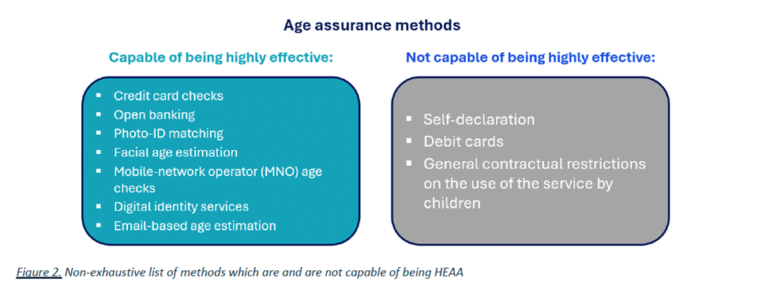
Supply: Joint Assertion, web page 5.
The Joint Assertion highlights that the OSA doesn’t require companies to set a minimal age. Nonetheless, companies that select to take action should state the minimal age of their phrases of service and apply it persistently. Providers that don’t use extremely efficient age assurance to implement their minimal age should assume that underage kids are utilizing the service and should mirror this of their kids’s threat assessments and corresponding mitigations.
3. The ICO Emphasises that Age Assurance Can Assist Defend Youngsters’s Private Info.
From an information safety perspective, the ICO’s place is that age assurance might help organizations keep away from illegal processing of youngsters’s private info by stopping kids from accessing companies not appropriate for them, in addition to implement age-appropriate protections in accordance with the ICO’s Youngsters’s Code.
Stopping underage entry. The place a service just isn’t appropriate for youngsters beneath a sure age—as an illustration, the place a minimal age of 13 is said within the phrases of service—the ICO explains that the service will typically lack a lawful foundation for processing the private knowledge of youngsters beneath that threshold. The Joint Assertion identifies the implementation of an efficient “age gate” as one of the best ways to minimise the chance of illegal processing. Whereas the ICO doesn’t mandate particular applied sciences, it factors to facial age estimation, digital ID, and one-time picture matching as present viable examples for companies imposing a minimal age requirement.
Youngsters’s Code protections. The place a service is appropriate for youngsters (or kids above a sure age), the ICO maintains that the organisation’s focus needs to be on making certain an age-appropriate expertise in keeping with the ICO’s Youngsters’s Code. In these instances, companies ought to use age assurance strategies which can be proportionate to the dangers of the platform and supply enough confidence to use the Youngsters’s Code requirements based on the person’s age. The ICO’s Age Assurance Opinion additional explains how companies can use age assurance in a risk-based, proportionate method that complies with knowledge safety regulation. Within the Joint Assertion, the ICO reiterates that companies that lack dependable age info should apply the Youngsters’s Code requirements to all customers as a default baseline of safety (in a method that also displays no matter age info is offered to the group).
Whatever the particular age assurance methodology adopted, the Joint Assertion underscores that companies should adjust to the complete set of UK GDPR knowledge safety rules. In apply, because of this organizations might want to take measures corresponding to establishing a lawful foundation (and acquiring parental consent if required), making certain equity and transparency (together with by means of age-appropriate transparency notices), and demonstrating accountability (together with by means of Knowledge Safety Impression Assessments (“DPIAs”). On DPIAs, the ICO has revealed detailed steerage on DPIAs within the context of the Youngsters’s Code, together with instance DPIAs (accessible right here). Within the Joint Assertion, the ICO additionally highlights the supply of the Age Examine Certification Scheme (“ACCS”) to assist companies establish age assurance suppliers that meet UK knowledge safety requirements.
4. Two Sensible Examples Illustrate How the UK’s Security and Knowledge Safety Regimes Work together.
The Joint Assertion consists of two hypothetical compliance eventualities—one for a user-to-user pornography service and one for a big social media platform. The examples illustrate how a service can implement age assurance that meets each on-line security and knowledge safety necessities by setting out the hypothetical approaches to compliance in a side-by-side, two column chart.
Within the first instance, a user-to-user pornography service makes use of extremely efficient age assurance to forestall entry to pornographic content material, ensures that no such content material is accessible earlier than the age examine is accomplished, and takes steps to scale back circumvention threat. From an information safety perspective, the instance states that the service depends on authorized obligation as its lawful foundation for the age assurance processing, applies the information safety rules, supplies clear privateness info, gives mechanisms to problem inaccurate age selections, and evaluations its DPIA as dangers evolve.
Within the second instance, a big social media service with a minimal age of 13 makes use of extremely efficient age assurance to limit entry to a “Not Secure For Work” part (which incorporates pornography) and, individually, makes use of sturdy age assurance on the account-creation stage to establish and block customers beneath 13. The instance additionally emphasizes accountability measures, together with conducting a DPIA, making use of the information safety rules to the age assurance course of, and persevering with to evaluate whether or not the chosen method stays match for objective.
* * *
The Joint Assertion arrives at a second of intensifying regulatory concentrate on age assurance, each within the UK and throughout Europe. Because the starting of the yr, each UK and European regulators have introduced a number of enforcement actions and investigations beneath method referring to age assurance. The Joint Assertion enhances Ofcom’s name earlier this month for main platforms to report by April 30, 2026 on the steps they’re taking throughout 4 precedence areas—minimal age insurance policies, anti-grooming controls, safer algorithmic feeds, and threat assessments of latest AI options earlier than deployment. Individually, the UK Authorities’s session on kids’s on-line experiences stays open till Might 26, 2026 and can seemingly feed into the additional growth of extra guidelines on this space (as described in our earlier weblog put up right here). On the EU degree, the European Fee has revealed pointers on the safety of minors beneath the Digital Providers Act (as described right here) and has launched a blueprint for a privacy-preserving age verification answer—interoperable with the forthcoming EU Digital Identification Wallets—that’s presently being piloted in a number of Member States. As these cross-jurisdictional items of the privacy-protective age-assurance “puzzle” come collectively, organisations can have a number of sources of data to contemplate as they design and undertake their very own options.