

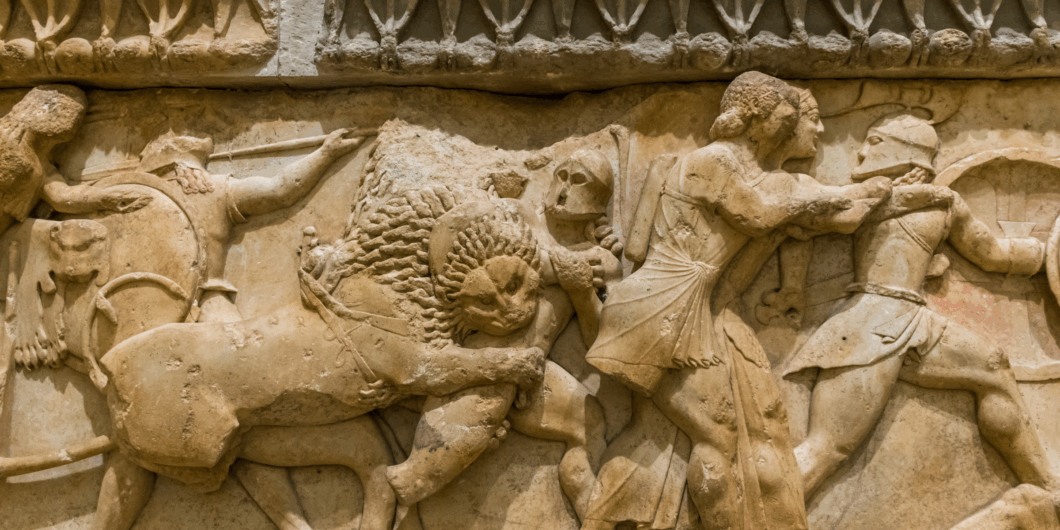
Should you say only one factor in regards to the historical Greeks, say that they’d good style. Most likely no tradition in historical historical past was extra famend for the wonder it produced than Athens throughout its Excessive Classical Interval, when the statesman Pericles oversaw a citywide rebuilding undertaking after the Persian invasion of 480 BC. The revolution in arts and letters that adopted was era-defining. In Virgil’s Aeneid, when the patriarch Anchises lists off the distinctions of civilizations moreover Augustan Rome, he pays his respects to peoples who can “mildew respiratory bronze” and “coax dwelling faces out of marble.” He doesn’t even have to say the Greeks by title—each reader would have realized who he was speaking about. The way in which Cubans are recognized now for his or her cigars and Scots for his or her whisky, Greeks have been recognized for making stunning issues.
As we speak, the phrase “classical” is virtually synonymous with a sure sense of purity and proportion, embodied in fluted columns and lissome marble nudes. However in Magnificence and the Gods: A Historical past from Homer to Plato, Hugo Shakeshaft argues that the Greeks have been enamored with magnificence nicely earlier than the Classical interval. His focus is on the Archaic interval, beginning round 800 BC when the epic poems of Homer have been first composed. These earlier centuries, Shakeshaft argues, set the stage for Classical authors like Plato to make loveliness itself an object of philosophical scrutiny. “Magnificence bore a transcendent energy and worth in Greek tradition lengthy earlier than Plato gave it new life in his philosophical musings,” he writes. So far as we will see from the historic report, the Greeks have been all the time in awe of magnificence. In the event that they got here to grasp it deeply within the age of Plato, that was as a result of they’d cherished it dearly because the age of Homer. Greater than that—they held it sacred. That’s what Shakeshaft’s ebook is about.
It’s not a ebook that can be relished from cowl to cowl by the final studying public. Shakeshaft, a postdoctoral fellow at Washington, DC’s Nationwide Gallery of Artwork, is a scholar writing for students. However that’s what makes Magnificence and the Gods so helpful as a repository of knowledge on its topic. These not within the behavior of studying tutorial prose for pleasure will nonetheless discover it helpful to seek the advice of the ebook on questions of explicit curiosity. The fabric is nicely organized into 5 chapters on the divine energy of magnificence in Greek epic, music, pure landscapes, structure, and figural artwork.
Shakeshaft’s strategy is a synthesis of artwork historical past, literary evaluation, and archaeology: there are shut readings of well-known poems like Homer’s epics and Sappho’s lyrics, but in addition detailed analyses of vase work and temple websites from Delphi to Sicily, richly complemented with colour photographs. The general impact is a form of immersion in what the world of Homer and Sappho should have regarded, felt, and gave the impression of. Shakeshaft manages to be nigh on exhaustive inside his chosen time interval—a formidable feat in itself with such an unwieldy and wide-ranging subject—and he makes some intriguingly delicate arguments alongside the way in which.
One early Christian author (erroneously, however splendidly) associated the Greek phrase for magnificence (kalos) to the phrase for “name” (kaleō). His level was that magnificence, varied and tough to outline as it might be, all the time calls us towards itself. It’s what makes issues actually enticing—the alluring face or the physique you may’t resist , the room you need to sink into and by no means go away, the panorama on the postcard that makes you want you have been there. This pressure of attraction makes magnificence really feel like a breath of one thing otherworldly wafting throughout the earthly airplane. If our bodies, rooms, and postcards have virtually nothing else in widespread, the factor they share should be one thing past all of them, one thing above our bodily existence. Within the language Medieval writers got here to make use of, magnificence is transcendental, on a par with different everlasting beliefs like goodness and being. It’s in however not of the world.
A tough factor about magnificence compared with the opposite transcendentals, although, is how usually it appears to be “within the eye of the beholder.” That cliché, in that kind, comes from Margaret Wolfe Hungerford’s Molly Bawn—a nineteenth-century novel recognized mainly for being talked about in Joyce’s Ulysses and for holding that line. Even there, in its first look, the saying is described as “an outdated axiom.” Hungerford wasn’t observing something about magnificence and its subjectivity that historical Greek authors hadn’t already observed. In certainly one of her justly well-known traces, the poet Sappho declared that “some say probably the most stunning factor on the darkish earth is a cavalry corps; some say a number of infantry; some say a fleet of ships. I say it’s no matter you’re keen on finest.” The coy vixens of Lesbos that made Sappho’s coronary heart flutter appeared worlds other than the deadly weapons that set the blood of extra martial poets racing.
As we speak, this reality is commonly cited in help of the fallacy that as a result of magnificence is subjective, it should be arbitrary. Archaic Greek thought on the topic was extra delicate than that. In fact magnificence is essentially one thing we understand (what else wouldn’t it be?), and it’s true, if considerably trivial, that completely different individuals generally understand it in several issues. Extra attention-grabbing is the truth that the expertise provoked by magnificence—the flutter of the guts, the racing of the blood—is recognizably comparable from individual to individual. The Greeks have been conscious of this too, and so they referred to as the common longing that magnificence conjures up by the title of affection. It was, they sensed, a primordial pressure holding the world collectively. “Love, most stunning among the many deathless gods,” was one of many first deities to set the world in movement in accordance with Homer’s tough up to date, Hesiod. On this mythology, writes Shakeshaft, love “represents the generative pressure of attraction driving the cosmos’ evolution.”
Even probably the most earnest efforts at inventive revival will fall brief except they aspire upward to that increased supply of magnificence, the wellspring from which all goodness additionally flows. There is no such thing as a true magnificence with out the gods.
That is an concept with an extended afterlife. It helped encourage Dante’s imaginative and prescient of God as “the love that strikes the solar and different stars.” It appeared to Francis Bacon like a precursor to the scientific precept that sure common forces clarify and drive “the pure movement of the atom.” Regardless of the powers are that draw hearth upward by means of the air and bind the chemical compounds of our our bodies collectively, they’re intently associated—if not an identical—to the tug that pulls the guts towards stunning issues. The Greeks’ infatuation with magnificence was not some frivolous pastime, adjoining to their extra severe philosophical curiosity in pure science. The 2 pursuits have been actually one and the identical.
To heed the decision of magnificence in its most refined varieties was, for Archaic Greeks, to return cheek to cheek with the final word powers of the universe. That is one widespread thread that Shakeshaft sees operating by means of virtually all of the sources he critiques, from the writing scrawled on the thighs of votive statues to the poetic reflections of the pre-Socratic philosophers. Magnificence is the factor people share most intimately with the gods in Greek theology: “Deities bestow magnificence on mortals, which likens them to deities and attracts their curiosity because of this.” Different teachers have puzzled over Archaic work and sculptures, questioning whether or not they depict gods and goddesses or stunning younger mortals. However Shakeshaft, in a pleasant little bit of anti-pedantry, argues that it might be lacking the purpose of such imagery to strive drawing the road too sharply between males and gods. Possibly it’s purported to be exhausting to inform the distinction. Possibly the entire level is that human loveliness is the closest factor on earth to a imaginative and prescient of the divine kind.
If this appears tantalizingly near the Biblical precept that mankind is made within the picture of God, that’s as a result of Greek storytellers have been coming from a unique angle at core truths that Jewish prophets additionally embedded into their scriptures. Shakeshaft often takes inventory of Close to Jap hymns and poems, together with these within the Bible, which dwell on comparable themes. “Oh worship the lord,” say the psalms, “in the great thing about holiness!” Few societies on earth, besides some very trendy ones, have doubted that magnificence is a present shared with this world from past. If the Bible tends to emphasise the great thing about holiness, nevertheless, the Greeks tended to insist on the holiness of magnificence. Wherever they discovered it occurring in nature, they assumed the gods have been there—a lot in order that the Roman encyclopedist Pliny the Elder had the Greek pantheon in thoughts when he wrote that “timber served as the primary temples of the gods.”
If magnificence is sacred, it’s tempting to imagine that it’s additionally a mark of divine favor. The Greeks of the Classical interval had a phrase, kalokagathia, which got here from mashing the phrase for “stunning” and the phrase for “good” collectively. Some interpreters have taken this to imply that, as artwork historian Alexandra Sofroniew places it, “the traditional Greeks believed that being stunning on the surface was a mirrored image of a superb individual on the within.” Shakeshaft deftly places paid to this notion: “such statements drastically misrepresent Greek sources,” he writes. From Homer on down, Greek writers simply distinguished between what we would name “internal” and “outer” magnificence. Among the many warriors of the Iliad, Paris on the Trojan facet and Nireus on the Greek facet are each good-looking weaklings with fairly faces however little martial prowess to talk of. All the identical, the very concept of kalokagathia betrays a willingness to affiliate excellence of kind with excellence of character. In Greek story and statuary, gods appear simply as inclined as mortals to the misapprehension that being good to have a look at means being good per se.
This was and stays probably the most troubling factor about magnificence. “Fact, Magnificence, and Goodness” are sometimes grouped collectively because the three nice transcendentals, and Keats—channeling what he took to be Greek knowledge—even went as far as to say that “magnificence is reality, reality magnificence.” But when goodness is clearly good and the worth of reality wants little protection, magnificence usually comes paired with idiocy, frivolity, and outright villainy. It might deceive and perplex in addition to enrapture. Magnificence is so clearly fascinating that it’s exhausting to not really feel as if it ought to, in a simply world, belong to good and ethical individuals. In the true world, issues don’t all the time work out that manner. Hesiod might have been proper that magnificence itself attracts the world collectively in love, but it surely’s equally true that stunning issues can come imbued with different, extra sinister traits. The artists of the Archaic interval have been alive to this complexity, although they don’t appear to have solved the issues it posed.
In a way, that will have been what Plato was making an attempt to do in certainly one of his biggest dialogues, the Symposium. Shakeshaft factors out that this watershed within the historical past of thought drew deeply on ideas already latent within the Greek custom. “A part of its brilliance lay in calling on conventional concepts and repurposing them.” The dialogue is ostensibly a sequence of speeches in reward of affection. When Socrates’ flip comes to talk, although, he relays a lesson he discovered from the priestess Diotima in regards to the holiness of magnificence. Love is a greedy beggar, a toddler of poverty, in quest of stunning companions to mate with. However the magnificence love finds instantly at hand on the planet is jumbled and confused, “twisted up with flesh and males and issues and all the remainder of that mortal junk.” A soul that wishes to refine itself has to look at its personal need for stunning issues—stunning individuals, stunning art work, stunning concepts—till it siphons off the essence of magnificence that’s mirrored in all these issues and but distinct from them. In itself, earthly magnificence is riddled with impurities. It’ll ultimately decay and deceive. However it is usually a glint thrown off from a larger mild on excessive. Understood in that manner, it may possibly result in God.
Shakeshaft refrains from intervening in up to date politics, however the mental historical past that results in and from Plato is most positively nonetheless unfolding. A current Calvin Klein advert, that includes the overweight rapper Chika Oranika spilling out of her underwear, has grow to be consultant for a lot of of a long-running effort to strip bodily attractiveness of any that means or worth in any respect. Often that is executed by insisting on ugliness the place magnificence is clearly to be anticipated. One predictable response has come from “vitalists” and different Nietzscheans who assert that toned our bodies and sq. jaws do, certainly, correspond to ethical advantage and genetic the Aristocracy. President Trump’s intervention into this debate, in each of his phrases, has been to situation govt orders “selling stunning federal civic structure.” This interprets on to reviving the neo-classical model favored by America’s early architects.
Critics of the orders have portrayed them as representing an endorsement of the view that there actually isn’t any daylight between kalos and agathos. However there’s one other manner of issues to be discovered from the Greek custom. If it’s fallacious to equate visible magnificence with ethical goodness, it’s additionally dishonest and unacceptably absurd to disregard the manifest non secular worth of magnificence altogether. The trick, as Diotima defined, is to treat even probably the most ravishing earthly magnificence as consultant on the bodily airplane of one thing a lot increased on the non secular airplane, one thing “that all the time exists and by no means modifications or passes away.” Even probably the most earnest efforts at inventive revival will fall brief except they aspire upward to that increased supply of magnificence, the wellspring from which all goodness additionally flows. There is no such thing as a true magnificence with out the gods.