

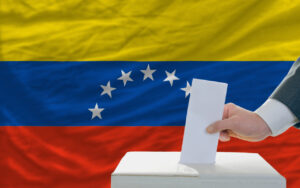
Hopes that Venezuela’s oil trade might resurge to fulfill the fixed demand for this key useful resource have pale with the contested outcomes of Venezuela’s Presidential elections held on July 28, 2024. The present President, Nicolás Maduro, and the opposition candidate, Edmundo González, have each claimed victory.
Maduro has doubled down and rejected requires impartial verification of the elections. In the meantime, there are deep considerations in regards to the Maduro authorities’s dedication to the professional switch of political energy which underlie the sanctions on Venezuela’s oil sector which were in place since January 2019.
Why Does This Matter?
Though at present producing at lower than half its capability, Venezuela holds the world’s largest confirmed oil reserves. Earlier than the sanctions, america, China, and India have been the most important consumers of the nation’s oil.
Venezuela was additionally the principle oil provider for a number of Caribbean and Central American nations which, via the PetroCaribe association, acquired buy phrases that gave the members as much as 25 years to pay their oil payments. For these cash-strapped nations which spend a big and growing proportion of their GDP on oil imports, PetroCaribe turned a lifesaver upon its introduction in 2005.
After sanctions have been imposed in 2019, Russia, already Europe’s main provider, stepped in to assist fill the hole. Then got here Russia’s February 2022 invasion of Ukraine and the following imposition of sanctions on Russia’s oil and gasoline sectors, amongst others.
Considering Iran and Libya, oil exports from 4 of the world’s high ten holders of oil reserves are at present banned or managed. Rising instability within the Center East provides one other ingredient of concern to this bleak image and its end result – rising oil costs.
As a pathway to reversing this case, Venezuela represents “low-hanging fruit”, so to talk. To reduce the impression of sanctions in opposition to Russia on their economies, European nations would welcome a pivot in direction of Venezuela. Caribbean and Central American nations might resurrect PetroCaribe, or an analogous association, one thing Venezuela has indicated it’s keen to do. These potentialities require the lifting of sanctions.
Sanctions Stops and Begins
In the direction of this finish, in 2022 the U.S. started to ease sanctions restrictions, issuing a license for Chevron, the US vitality firm, to renew manufacturing and the export of petroleum merchandise. Supposed as encouragement for the Maduro authorities, this method appeared to be working when on October 18, 2023, the Authorities and Opposition – Plataforma Unitaria Democrática – signed the Barbados Settlement laying out a path to aggressive elections. In response, the U.S. additional eased sanctions, together with a six-month normal authorization of transactions involving Venezuela’s oil and gasoline sector.
When main election outcomes confirmed the energy of the Opposition, nevertheless, the Maduro authorities started to renege on the Barbados Settlement. It imposed a ban on the candidacy of the Opposition’s chosen candidate for the July 2024 election, which Venezuela’s Supreme Court docket upheld. In response, in January 2024, the U.S. revoked the final authorization granted lower than three months earlier. The contested election outcomes and intransigence of the Maduro authorities counsel that this newest re-start to Venezuela sanctions might proceed for a while.
The impression of those begins and stops is especially worrisome to Trinidad and Tobago, a Caribbean oil and gasoline producer. Positioned seven miles off Venezuela’s coast at its closest level, a number of gasoline fields straddle the maritime boundaries of the 2 nations. Plans for his or her joint exploration have hit a number of sanctions stops and begins.
The most recent flip occurred in Might 2024 when Trinidad and Tobago was however granted a license by the U.S. to pursue an settlement reached with Venezuela for a 20-year pure gasoline manufacturing and exploration deal of one of many fields. Nothing prevents the U.S. from rescinding this license ought to it determine to strengthen sanctions in gentle of the result of the July elections.
What Subsequent?
The worldwide neighborhood has been divided in its response to Venezuela’s elections. An try by the Group of American States (OAS) to forge a unified name for an neutral verification of the election outcomes failed by one vote. Many nations, a number of within the Caribbean included, appeared torn on the problem, maybe due to their financial pursuits. Who can blame them?
Maybe it’s time to significantly think about whether or not financial sanctions are an efficient coverage instrument. Their supposed purpose is to induce political change. In idea, sanctions create strain that leads both to a course correction by the federal government or an rebellion from under that creates a regime change. The authors of How Sanctions Work: Iran and the Affect of Financial Warfare query this idea.
Iran was first sanctioned in 1979 and is at the moment the second-most sanctioned nation on the planet. But, the Islamic Republic of Iran has survived to grow to be one of many strongest threats to U.S. coverage within the Center East. The financial system of Russia, the most-sanctioned nation, has not solely survived however, not less than for the second, apparently thrived.
To the extent that they have an effect, sanctions assist pressure the nation’s populace into hardships that the management finds methods to bypass. Sanctions also can undermine the financial system of commerce companions and their productive capability. Sanctions are being ignored by extra nations, undermining their effectiveness.
In contemplating learn how to obtain the specified coverage objectives vis-à-vis Venezuela, the questionable outcomes of many years of financial sanctions point out that they might be greatest achieved utilizing the normal technique of sustained engagement and strategic diplomacy.
The put up The World Affect of Venezuela’s Disputed Elections first appeared on DevelopTradeLaw.