

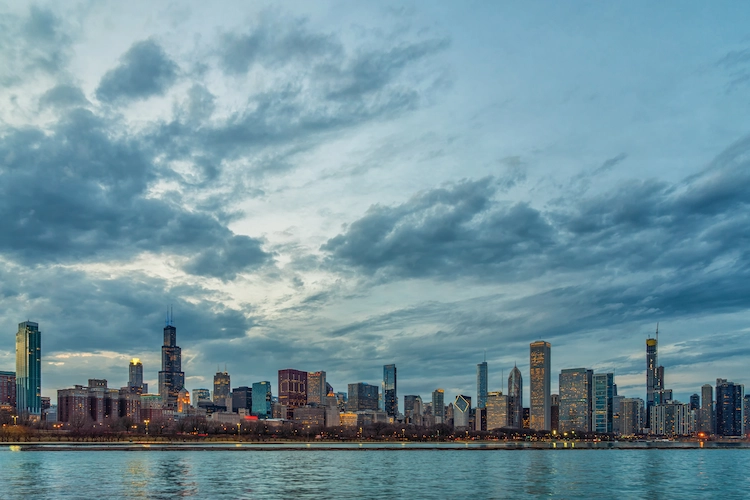
In Trump v. Illinois, 607 U.S. ____ (2025), the U.S. Supreme Courtroom refused to remain a district court docket order stopping the Trump Administration from federalizing and deploying the Nationwide Guard inside Illinois.
Info of the Case
On October 4, 2025, President Donald Trump invoked his authority underneath 10 U.S.C. § 12406 to federalize and deploy members of the Nationwide Guard inside Illinois, over the objection of the state’s Governor. The statute empowers the President to federalize members of the Guard if he’s “unable with the common forces to execute the legal guidelines of the US.”
In calling for the Guard, President Trump asserted that deploying the Guard within the state was essential to quell violent assaults towards federal immigration brokers and property. The State of Illinois and the Metropolis of Chicago subsequently filed swimsuit towards President Trump and members of his administration, arguing that not one of the statutory predicates for federalizing the Guard underneath § 12406 had been met, and that the federalization additionally violated the Tenth Modification and the Posse Comitatus Act, 18 U.S.C. § 1385.
U.S. District Decide April M. Perry issued an order that prohibited the federal authorities from “ordering the federalization and deployment of the Nationwide Guard of the US inside Illinois.” She discovered that neither of the predicate situations for federalization proffered by the administration was current in Illinois: There was insufficient proof of insurrection or a hazard of a insurrection, 10 U.S.C. § 12406(2), nor was there sufficient proof that the President was unable with the common forces to execute the legal guidelines of the US
“The agitators who’ve violated the regulation by attacking federal authorities have been arrested,” Decide Perry wrote. “The courts are open, and the marshals are able to see that any sentences of imprisonment are carried out. Resort to the navy to execute the legal guidelines shouldn’t be known as for.”
The Seventh Circuit Courtroom of Appeals upheld the ruling. In keeping with the appeals court docket, “[t]he spirited, sustained, and infrequently violent actions of demonstrators in protest of the federal authorities’s immigration insurance policies and actions, with out extra, doesn’t give rise to a hazard of insurrection towards the federal government’s authority.” The Seventh Circuit additional discovered “inadequate proof that protest exercise in Illinois has considerably impeded the flexibility of federal officers to execute federal immigration legal guidelines.”
The Authorities requested the Supreme Courtroom to remain the District Courtroom’s order. The Courtroom directed the events to deal with a difficulty that their preliminary briefs had not: the that means of the time period “common forces” in §12406(3). In its supplemental temporary, the Authorities argued that the time period refers to civilian regulation enforcement officers, akin to these employed by Immigration and Customs Enforcement or the Federal Protecting Service. Respondents, echoing the District Courtroom, maintained that the time period refers back to the common forces of the US navy.
Majority Ruling
By a vote of 6-3, the Supreme Courtroom denied the Authorities’s software for a keep. “At this preliminary stage, the Authorities has did not establish a supply of authority that will permit the navy to execute the legal guidelines in Illinois,” the Courtroom wrote in a quick, unsigned opinion.
In reaching its choice, the Courtroom concluded that the time period “common forces” in §12406(3) seemingly refers back to the common forces of the US navy. It went on to clarify that this interpretation signifies that to name the Guard into energetic federal service underneath §12406(3), the President should be “unable” with the common navy “to execute the legal guidelines of the US.” It wrote:
As a result of the statute requires an evaluation of the navy’s capacity to execute the legal guidelines, it seemingly applies solely the place the navy might legally execute the legal guidelines. Such circumstances are distinctive: Underneath the Posse Comitatus Act, the navy is prohibited from “execut[ing] the legal guidelines” “besides in instances and underneath circumstances expressly approved by the Structure or Act of Congress.” So earlier than the President can federalize the Guard underneath §12406(3), he seemingly should have statutory or constitutional authority to execute the legal guidelines with the common navy and should be “unable” with these forces to carry out that perform.
Thus, at this stage of the case, the Courtroom decided that the federal government has not carried its burden to indicate that §12406(3) permits the president to federalize the guard within the train of inherent authority to guard federal personnel and property in Illinois.
Dissent
Justices Samuel Alito Jr., Clarence Thomas and Neil Gorsuch dissented. “I’ve severe doubts concerning the correctness of the court docket’s views. And I strongly disagree with the way by which the court docket has disposed of this software,” Justice Alito wrote. “There isn’t any foundation for rejecting the President’s dedication that he was unable to execute the federal immigration legal guidelines utilizing the civilian regulation enforcement sources at his command.”
The publish Supreme Courtroom Halts Deployment of Nationwide Guard to Chicago appeared first on Constitutional Legislation Reporter.